
Movement to Metrics: Unlock Better Running with Stryd
21 October 2026 | Category: Running Technique Advice
This guide was first published by Stryd in the Stryd Learning Center. It was written with Paul Mackinnon and edited by Ka’eo Kruse, Stryd’s Applied Human Performance Scientist.
Why should I read this?
Running form, Stryd Footpath, and performance metrics are often discussed in isolation — but in reality, they are inseparably linked. Each stride you take is a system of movements that produces measurable outcomes, and understanding this system is the key to unlocking your full potential as a runner.
In this article, you’ll learn how your movement patterns (Form) shape your Stryd Footpath, how those Stryd Footpath visualizations reveal hidden details of your technique, and how both feed directly into the Metrics you track every day. With insights from running technique expert Paul Mackinnon, we’ll show how these three components create a dynamic feedback loop that can help you run more efficiently, prevent injury, and make meaningful progress in your training.
Whether you’re trying to break through a performance plateau, correct recurring inefficiencies, or simply understand how your body moves, this integrated approach will give you the clarity and tools you need to become a smarter, stronger runner.
Meet Paul Mackinnon, The Balanced Runner

I’ve spent the past decade working with runners of every level — from recreational athletes chasing new personal bests to some of the world’s top professionals. Today, I work with National Record holders in both Australia and the United States, including Brett Robinson, Izzi Batt-Doyle, Cam Wurf, Ellie Salthouse, Nico Young, Galen Rupp, Karissa Schweitzer, and Molly Seidel, among many others.
With a background in sports science and teaching, I’ve developed a unique coaching process that blends self-awareness with a top-down approach to movement. My focus is always on improving efficiency — helping athletes make the most of the physics of running while working within their individual capacities.
Through my company, The Balanced Runner (tbrunner.com), I coach athletes in person and through a complete online video series. This method has helped runners succeed across every distance — from 400 meters on the track to ultramarathons — and even in team sports where repeated sprinting and change-of-direction are key.
At the heart of my coaching is a simple joy: seeing athletes recognize improvement in real time. There’s nothing more rewarding than watching someone feel the difference that efficient movement makes — not just in performance, but in the sheer enjoyment of running.
My Philosophy on Form: Physics Meets Physiology
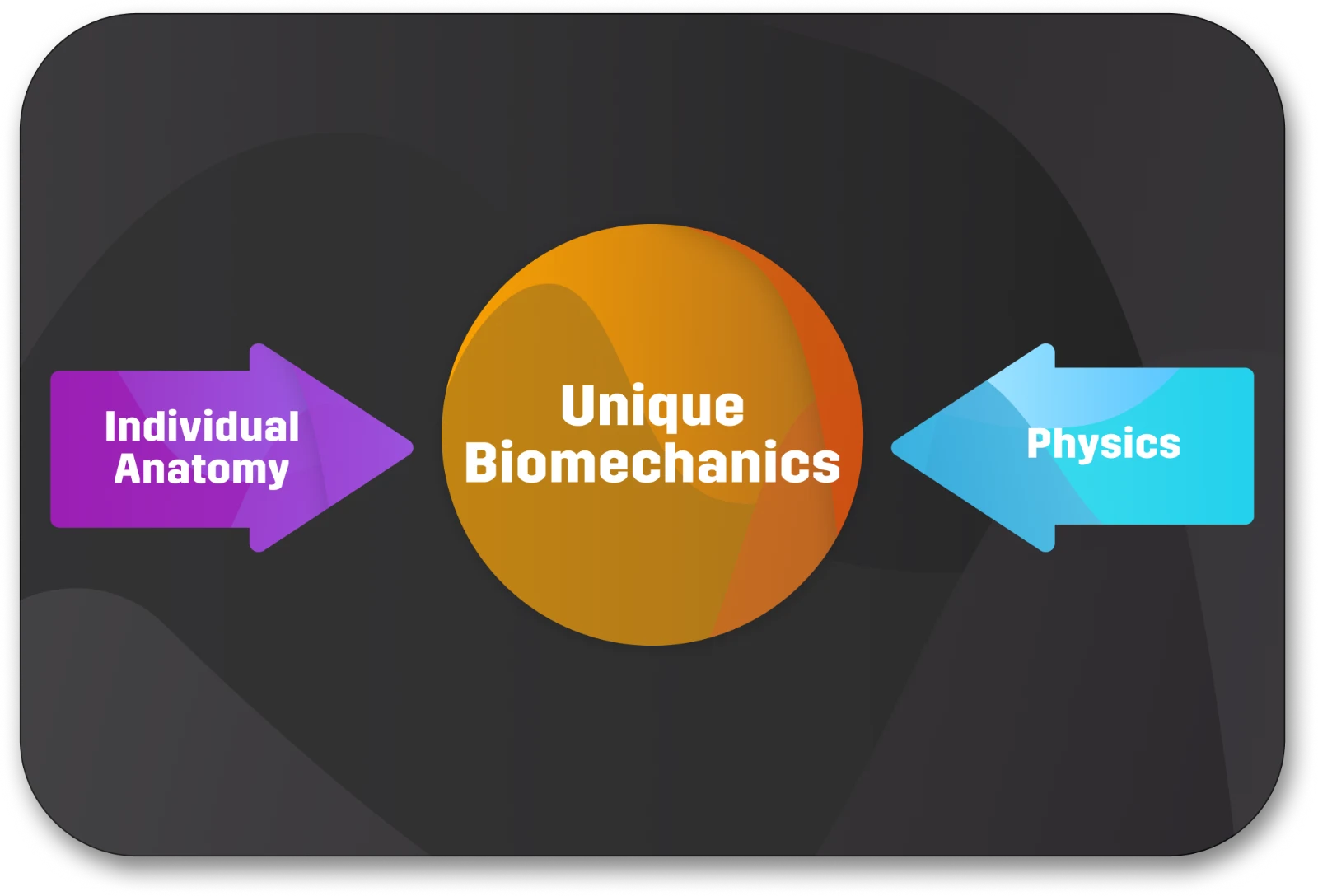
No matter who you are — tall or short, new to the sport or a seasoned veteran — you can’t outrun physics. Running is always governed by three constants: gravity, your center of mass, and a distance you’re covering. These never change.
It is our mass that we are moving. Our legs are absorbing and applying force. The ground is our leverage.
But while physics stays the same, each individual brings their own limitations and strengths. Injury history, range of motion, and anatomy all shape how you move. This combination of universal physics and individual traits create your unique biomechanical signature — what we commonly call your running form.
And here’s the key: even if no one has “perfect biomechanics,” everyone can still learn to move more efficiently within the framework of physics.
Why Gravity Matters Most
Think about the one constant in every step you take: gravity. Running is essentially a battle against it. Every footstep is an attempt to leave the ground while gravity pulls you back down.
We are at our most efficient when we are off the ground and traveling forward. To achieve this, research and practice show we need roughly 80% of our force directed vertically and 20% horizontally for steady state running. That’s the sweet spot for maintaining momentum when running.
To visualize this, imagine standing still and jumping straight up and down continuously. That’s 100% vertical force — flexing and extending at the ankle, knee, and hip to push yourself skyward. Running is simply a controlled version of this jump repeated step after step, tuned to an 80/20 split of vertical and horizontal forces.
Why Small Movements Matter
Each time your foot hits the ground, you lose some energy to braking forces. That’s unavoidable. The goal is to minimize those losses so you don’t have to waste extra energy replacing them.
Here’s the problem: not all our movements line up neatly in that 80/20 vector. Some arm swings, torso rotations, or side-to-side leg motions push energy laterally instead of forward. Over time, those “extra” movements add up and leak efficiency.
Think of it like carrying two buckets, each weighing 20 kilos.
- One is filled with sand: steady, predictable, easy to move from A to B.
- The other is filled with water: it sloshes around, and you waste energy just trying to stabilize it.
That’s the difference between a runner with efficient form and one with excess, unstable movements. Both are carrying the same “weight,” but one is working a lot harder to get to the finish line.
The Core Belief
We are the summation of all our movements — and they all matter. The more aligned those movements are with the physics of running, the smoother, faster, and more efficient you’ll be.
When you start thinking about form through this lens of physics, it opens the door to measuring and understanding it in new ways. That’s where tools like Stryd become incredibly valuable. By translating these principles into data you can see, Stryd provides a clear picture of how your movements play out in real time — and gives you the opportunity to make small changes that add up to big improvements.
You’ve probably already tried to make improvements based off the Stryd metrics and Stryd Footpath, but why not try a more structured and informed approach?
“Think of it like carrying two buckets, each weighing 20 kilos.
- One is filled with sand: steady, predictable, easy to move from A to B.
- The other is filled with water: it sloshes around, and you waste energy just trying to stabilize it.
Both are carrying the same “weight,” but one is working a lot harder to get to the finish line.”
What Does Good Form Look Like?
Picture two runners side by side. They’re equally fit, moving at the exact same pace. One looks smooth, light, and effortless. The other looks like they’re working twice as hard. Even without a coaching eye, most people can tell which runner has better form — it simply looks more fluid. There is less impact, more flight and no excessive movement.
But what is actually happening when someone runs with “good form”? Let’s break it down.
The Upper Body
Efficient running starts with the arms. A compact, symmetrical arm swing close to the torso helps drive the body upward and forward. The upper arm does most of the work, and the swing happens evenly both in front of and behind the body. Nothing looks rushed — it has rhythm.
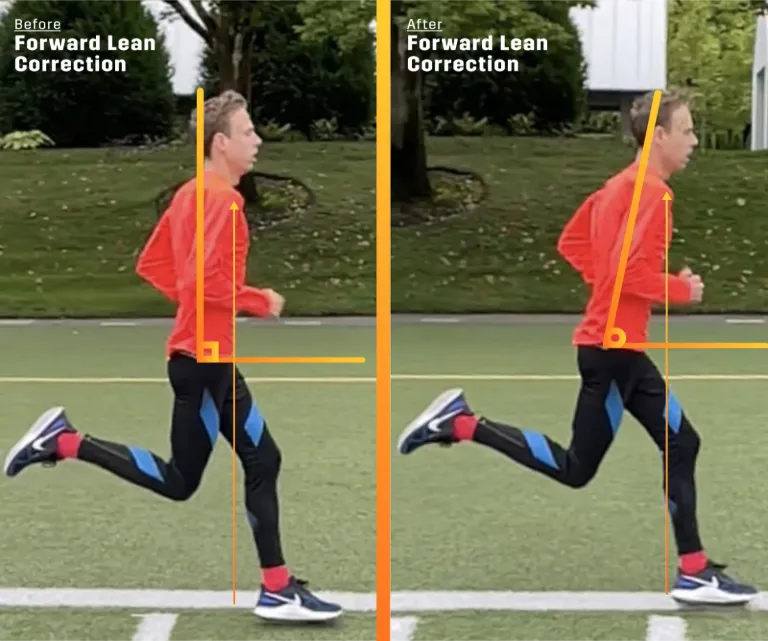
The torso plays an equally important role. It should be stable, not stiff, with the spine holding a soft S-curve from head to tailbone. If you were to draw a straight line from the top of the head down to the tailbone, that line would sit at about a 75-degree angle (varies slightly by runner and pace). This slight forward lean gives the body balance, helps transfer force smoothly, and allows the legs to work efficiently beneath you.

The Lower Body
The legs lead from the hip, with the femur acting as the main lever. The lower leg follows under and behind, amplifying force instead of kicking out in front. This sequence keeps the motion compact and efficient, allowing power to flow naturally through each stride.
When done well, the movement looks smooth and unhurried — almost as if the runner has more time in each step. That rhythm and control give the impression of ease, even at faster paces, and allow the foot to travel on a steady path beneath the center of mass.
In practice, these helpful mechanics often show up in data: shorter Ground Contact Time (GCT) at a given pace, longer stride length, and more flight time that reflects balanced, efficient movement. A Stryd Footpath that stays closer to the center of mass is another strong indicator of economy.

Aspects of Good Form:
- 75 degree forward lean.
- Compact, symmetrical arm swing.
- Legs lead from hip and drive with thigh, lower leg follows.
- Lower leg doesn’t kick out in front of CoM.
Common Form Mistakes
Now that we’ve looked at what good form should look like, it’s important to contrast it with the most common ways runners lose efficiency. Just like with good form, mistakes tend to show up in two areas: upper body and lower body.
The Upper Body
One of the most common errors is not swinging the arms enough. The arms act as counter-movers to the legs, helping to balance and drive the stride. If the arm swing is restricted, the legs often become rushed, restricted, or overworked.
Another frequent mistake is trying to swing the arms in a perfectly straight line forward and back. The shoulder joint simply isn’t built for that — it naturally sits at about a 45-degree angle. Forcing a straight-line swing means you have to pull your shoulders back and tense your upper body, shifting your center of mass behind you. That tension not only wastes energy but also makes it harder to run tall and relaxed.
When the upper body isn’t contributing properly, the body finds movement elsewhere — through torso rotation, rib cage rolling, or hammering with the lower arms. These “compensation patterns” may feel natural, but they’re far less effective than a strong, compact swing from the shoulders.
From a physics perspective, this extra twisting is costly. Instead of directing forces upward and forward (the efficient 80/20 balance), sideways forces are created that waste energy and slow you down. Running efficiently is about getting off the ground, not twisting side to side — think vertical lift, not rotation.
What this often looks like in practice:
- Torso rotation that pulls the body side to side
- Arms crossing slightly in front of the body
- Shoulders rolling or rib cage shifting to compensate
Better focal points for the upper body:
- Use your arms to help drive upward as well as forward — much like you would when jumping.
- Keep the chest and shoulders still (but not stiff). Isolating movement into the shoulder joint gives the torso the best chance to remain stable.
The Lower Body
On the lower-body side, one of the biggest misconceptions is chasing cadence. Many runners fixate on hitting a magic number, but cadence is simply an outcome of your movement patterns — not something to force. Two runners can run at the same pace with the same cadence, yet one is smooth and efficient while the other is overstriding, braking heavily, and wasting energy.
That’s why cues like “increase your cadence” often backfire. For one runner, increasing cadence might mean taking smaller, choppier steps without fixing the underlying mechanics — essentially working harder for no gain. For another, the same cadence could come from lifting cleanly from the hip, leaving the ground quickly, and carrying momentum forward. The difference is in the movement quality, not the step count.
Another misunderstood area is the landing. You’ve probably heard the cue “land under your hips.” On the surface it sounds helpful, but it ignores physics. You don’t try to place your foot directly under your center of mass (CoM); instead, you move your body so that your CoM naturally passes over the landing. Stride length and posture — not chopping your stride shorter — determine that position.
Here’s a simple way to feel the difference: jump up and down like you’re skipping rope, then try the same thing landing on your heels. You’ll notice how much harder it is to recycle energy when the calf and Achilles can’t contribute as much. Running works the same way — it’s not that one landing style is “wrong,” but certain mechanics set you up to reuse energy more effectively.
What this often looks like in practice:
- Stride reaching too far ahead of the body (overstriding)
- Lower leg dominating the movement rather than lifting from the hip
- A landing position that makes it harder to reuse stored elastic energy
Better focal points for the lower body:
- Reduce GCT by focusing on leaving the ground earlier — not by forcing cadence or shortening stride. This naturally increases flight time without adding extra cost.
- Let the upper leg drive the movement. Overstriding often happens when the lower leg dominates (a walking-like pattern). By lifting from the upper leg first, you keep movements compact and efficient.
Common Form Mistakes to Watch:
- Not swinging arms enough.
- Trying to swing arms in a perfectly straight line.
- Over-rotation of the arms and torso.
- Chasing cadence.
- Forcing your footstrike under CoM instead of moving CoM over footstrike.
The Hierarchy of Form, Stryd Footpath, and Metrics
Up to this point, we’ve been looking at running purely through the lens of form — how the body moves, where inefficiencies creep in, and what good movement looks like. But form doesn’t exist in isolation. With Stryd, we can also quantify how that form is expressed through Stryd Footpath and reflected in Metrics.
Form, Stryd Footpath, and Metrics are three different ways of looking at the same thing: how you run. Each gives you information about your movement at a different level. Too often, runners focus on one in isolation — chasing a number in their metrics, drilling a single form cue, or staring at a Stryd Footpath pattern — without realizing they’re all connected and influence one another.
Think of them as stacked layers:
- Form is the top level — the way your body actually moves.
- Stryd Footpath sits in the middle — a visual trace of how those movements are expressed through the lower body.
- Metrics sit at the base — the measurable outcomes that reflect the total cost, symmetry, and efficiency of those movements.
Each layer affects the others. Change your form, and you’ll see it reflected in Stryd Footpath and Metrics. But the reverse can also be true — focused work to improve a metric like Leg Spring Stiffness (LSS) or GCT through drills, strength, or mobility can reinforce better movement patterns and, over time, reshape your form itself. When used together, these three levels give you a full, multi-dimensional picture of how your running is evolving.

Form
Form is the sum of all your movements. From head to toe, every posture and motion shapes the way you run. It’s the starting point, and it governs what shows up in both Stryd Footpath and Metrics.
The direction, range, and timing of your movements determine how efficient your form is. Helpful movements reduce GCT, increase flight time, and make running feel smoother. Inefficient movements add unnecessary cost.
Stryd Footpath
Stryd Footpath provides a visual record of how your form plays out in motion. It traces the path your foot travels through the air, highlighting the direction, range, and symmetry of your lower-body movements.
It’s not the complete picture of form, but it’s a valuable middle layer. Stryd Footpath helps you see whether the cues and drills you’re working on are translating into more efficient mechanics — and whether those improvements hold up throughout an entire run, workout, or race.
Metrics
Metrics are the quantitative layer — the outcomes that give you hard data on your movement. They measure how your form and Stryd Footpath express themselves in the real world through values like GCT, Cadence, Impact Loading Rate (ILR), Vertical Oscillation (VO), LSS, Left/Right Balance, and Power.
Metrics don’t exist apart from movement; they’re the feedback loop that makes change measurable. While chasing a number in isolation can miss the mark, targeted training to improve a specific metric can strengthen the mechanics behind it. In this way, metrics both reflect and reinforce your form — helping you track progress, confirm improvement, and, when paired with the right drills and cues, even drive it.
An Example of the Hierarchy in Action
Form, Stryd Footpath, and Metrics together make up one complete system: Form drives everything, Stryd Footpath shows how those movements are expressed, and Metrics confirm and quantify the results. When you use all three, you can see not just what’s happening, but why.
For example, drills and strength training can improve LSS and ILR — two key performance metrics. But if your running form includes overstriding or a landing pattern that limits how much the Achilles can contribute, you won’t fully capture those gains. The metrics might look better, but the movement pattern isn’t efficient enough to translate them into performance.
That’s where this full, three-level system comes in: metrics reveal the progress, Stryd Footpath shows how you’re achieving it, and form explains whether the movement itself is truly efficient.
“Form, Stryd Footpath, and Metrics are three different ways of looking at the same thing: how you run. Each gives you information about your movement at a different level. Too often, runners focus on one in isolation without realizing they’re all connected and influence one another.”
Putting the Hierarchy into Practice: Case Studies
So how does this play out in real running? To bring the hierarchy to life, we worked with Brady Holmer — Master of Science in Human Performance, author of Physiologically Speaking on Substack, and self-described performance nerd. With a 2:24 marathon PR from Boston 2025, Brady is known for being on the cutting edge of physiological science. Yet even an athlete this knowledgeable and well-trained demonstrates how easy it is to overlook the role of form — and how valuable it can be to view running through multiple levels of feedback.
Running form isn’t something only beginners can improve. Even experienced runners, those who track every metric and train with precision, can uncover new efficiency and resilience when they connect Form, Stryd Footpath, and Metrics. In this analysis, we’ll look at two examples — one in the upper body (torso rotation) and one in the lower body (overstriding)— to show how these three layers work together to reveal opportunities for improvement.
Reference Video:
Upper Body: Excessive Rotation
Excessive torso rotation is simply wasted energy. When you think of running as a balance between vertical and horizontal forces, rotation creates the wrong kind of force — it sends your mass side to side instead of up and forward. This sideways motion leaks energy and slows the rhythm of your stride.
As we discussed earlier, imagine the bucket analogy: carrying a bucket of water versus a bucket of sand. The sloshing water (rotational movement) costs more energy to stabilize. Similarly, too much rotation forces the rest of the body — especially the legs — to spend effort rebalancing instead of propelling forward.
One subtle but important consequence of this rotation is that the foot cannot leave the ground until the torso finishes twisting and begins to recoil. This delays lift-off and increases GCT. The longer the torso rotates, the longer you’re on the ground — which directly reduces efficiency.
Form


In Brady’s case, his arms swing wide from the body, creating a flatter, cross-body swing. This movement pulls the shoulders and ribcage into the motion, causing rotation. Notice how his right side drives down and through the torso — a kind of “rib roll” that isn’t mirrored on the left.
This pattern is the body’s way of staying balanced while moving forward, but it comes at a cost. The extra side-to-side movement doesn’t help oppose gravity or create flight — it’s a horizontal action when we need vertical lift.
We are, as I always say, a summation of our movements — and in this case, too many of those movements are working sideways instead of upward.
Stryd Footpath


Brady’s left Stryd Footpath shows how this imbalance plays out. The left foot travels slightly wider and lower during recovery than the right. That wider swing reflects the upper-body rotation — the foot moves out, then cuts back in toward the midline, adding unnecessary medial load and inefficiency.
If you look closely, you can see how this aligns with his torso position: when the right side drives down, the left hip drops slightly, leading to a lower recovery height and a diagonal path back to the ground. It’s a visual example of how movement from head to toe is connected — upper-body asymmetry creates a visible pattern in the lower body.
Metrics

The metrics reinforce what we see visually. While Brady’s Impact Loading Rate (ILR) is balanced, his Leg Spring Stiffness (LSS) differs significantly between sides. His right side — where he drives down more — shows higher LSS and slightly lower Ground Contact Time (GCT). This means he’s creating more spring and force on that side, but not symmetrically.
The result? A subtle imbalance in Vertical Oscillation (VO) and energy return that accumulates over thousands of steps. It’s not enough to cause immediate injury, but it represents untapped efficiency and potential fatigue down the line.
The Fix
The first step in fixing upper-body asymmetry is to restore symmetrical arm movement that helps the runner move upward, not sideways. The goal isn’t to eliminate movement but to direct it vertically — much like the arm swing you’d use when jumping.
Some runners also develop asymmetrical rhythm, where one arm swings slightly faster or slower than the other. This creates timing differences that ripple through the entire body. Restoring even rhythm helps reduce that lag.
Finally, remember that your shoulders aren’t built to swing in a straight line. The shoulder socket (glenoid fossa) sits at roughly a 45-degree angle for most people, so the most natural and effective swing follows that diagonal path. Directing your swing toward your chin — rather than straight forward — channels your effort upward, not across.
Symmetrical, vertically supportive upper-body motion improves LSS, GCT, and VO balance, helping runners create more lift and less waste.
Insight: Upper body form is reflected in Stryd Footpath and Metrics.
- Excessive rotation can commonly be expressed in a tilted Stryd Footpath that seems slightly rotated off center.
- This tilted footpath commonly expresses in more a more asymmetric ILR, LSS, GCT, or VO balance.
Lower Body: Overstriding
Overstriding is one of the most common and misunderstood running mechanics. It happens when the lower leg leads too far forward to “reach” for stride length. This shifts landing in front of the center of mass (CoM), increasing braking forces and GCT.
Heel striking often accompanies overstriding, but the landing itself isn’t the problem — it’s the position and timing of the landing. When the foot lands too far in front of the body, it forces a flat, pulling motion instead of a spring-like push. This adds cumulative stress over thousands of steps — what I call “death by a thousand cuts.”
By contrast, when the upper leg drives the motion, the lower leg follows as an amplifier of that movement. Picture climbing stairs: your upper leg lifts and drives you upward, and the lower leg naturally follows through. The same idea applies when running efficiently.
Form


In Brady’s case, the lower leg reaches forward to create stride length rather than flight. You can see the sole of the shoe before impact — a clear sign the foot is leading, not following.
When this happens, the landing occurs farther in front of the body, increasing braking force and time on the ground. The leg is often nearly straight at impact, meaning the muscles (especially the quads and IT band) must brace to absorb impact rather than recycle energy elastically.
This flat, reaching movement is the opposite of the controlled “jumping” action that makes running efficient.
Stryd Footpath
While Brady’s example shows what overstriding looks like in practice, the Stryd Footpath visualizations below are illustrative comparisons from similar mechanics so you can see the contrasts clearly.
Walk (Lower Leg dominant)


Overstriding (Lower Leg dominant)


No Overstriding (Upper Leg dominant)


When comparing walking, overstriding, and efficient running, the Stryd Footpath makes the difference clear. In overstriding, the foot sweeps far forward and upward, then cuts sharply downward — just like in a walking pattern.
In contrast, when the upper leg leads, the path is more compact both in front of and behind the body. The foot travels closer to the center of mass with higher recovery height, more vertical motion, and smoother transitions — all signs of greater efficiency.
Metrics
To make this comparison even clearer, the examples below visualize what the data looks like for each pattern — not from Brady’s specific run, but from similar mechanics.
Overstriding

No Overstriding

Metrics make these differences measurable. The overstriding pattern shows higher Impact Loading Rate (ILR) and Ground Contact Time (GCT) — meaning more force absorbed per step and more time spent absorbing it.
With a more efficient upper leg lead running mechanic, GCT decreases by roughly 30%, while Leg Spring Stiffness (LSS) improves by up to 40%, showing greater energy return from the lower leg and Achilles complex.
Also Vertical Oscillation (VO) is higher in the no overstriding pattern, which surprises many runners. You often hear that high VO is wasted energy — but that’s not always true. If VO creates flight and stride length, it’s productive. What matters most is Vertical Ratio (VR = VO ÷ Stride Length). In this case, VO rises proportionally with stride length (VO ratio stays the same), meaning the runner is getting more distance for the same effort.
The Fix
With any form change, the key is to start from the top and work down. Efficient movement begins with the arms and torso — they set rhythm and timing for everything below.
From there, the goal is to shift from a lower-leg-driven pattern to an upper-leg-driven one. The difference is easy to feel: in a lower-leg pattern, it’s as if you’re standing beside a treadmill, pulling the belt backward with your foot. In an upper-leg pattern, the lift starts from the hip, creating more upward force and less braking.
Think back to running uphill or climbing stairs — that’s the feeling you want. Once that movement becomes natural, you can better absorb and push off the ground with elastic efficiency.
Here’s an example of how a runner used this top-down approach to transform their overstriding in just a few sessions:
Insight: Vertical Oscillation (VO) should always be evaluated with Vertical Ratio (VR) and/or Form Power.
- If VO rises and VR and/or Form Power stays stable or improves, that added up-and-down is productive—creating flight and stride length, not wasted bounce.
Bringing It All Together

We’ve covered a lot of detail — from how small upper- and lower-body movements affect performance, to how those differences show up in Stryd Footpath and metrics. But form isn’t just something to analyze; it’s something to feel and refine over time.
Now that we’ve seen what those inefficiencies look like in real runners, let’s step back and talk about how to put it all together — how to use form, Stryd Footpath, and metrics to actually guide your improvement.
Each stride you take is a system of movements that produces measurable outcomes — and understanding that system is the key to unlocking your full potential as a runner. Form, Stryd Footpath, and Metrics work together to determine your mechanical efficiency. Each layer tells part of the story, but when you look at them together, you can see both where you are and where to go next.
Step 1: Identify What to Improve
Start by identifying what you want to improve — whether it’s movement symmetry, vertical ratio, or GCT. You can do this through video, or by examining your Stryd Footpath and Metrics. These data points can help pinpoint the areas where your movements start to drift or break down, especially when you’re tired or pushing hard.
The key is self-awareness: noticing when your form starts to change and what changes first. That understanding is the foundation of lasting improvement.
Step 2: Make Targeted Changes
Form can change instantly with the right cues. That’s the starting point for building better movement patterns. When one cue clicks, it often opens the door for the next — each improvement building on the one before it.
From there, you can support those changes with the right strength, mobility, and drills. Each addition helps make your improved form more stable, more powerful, and more automatic.
Step 3: Track and Measure Progress
This is where Stryd is most useful. Your Stryd Footpath and metrics let you track how those form changes hold up — over time, under fatigue, and across different intensities. You can see if a cue is creating the intended effect or if you need to adjust it.
Maybe your left-right balance evens out. Maybe your LSS increases or your GCT drops. Or maybe your form looks great early in a run but breaks down late — revealing where to focus next. This continuous feedback loop is how you close the gap between how you move and how you want to move.
Without that feedback, you’re just throwing darts in the dark and hoping to hit a bullseye. With Stryd, the room is no longer dark — you can see exactly what’s happening and why.
Step 4: Connect the Physics and the Feeling
Remember running is, at its core, controlled jumping — the art of using gravity and momentum to move efficiently. Once you understand the physics, you can start shaping your movements to work with those forces rather than against them. Every improvement in your form becomes something you can feel: smoother, lighter, more powerful.
That’s the beauty of combining science and self-awareness — the numbers explain why, but the feeling tells you it’s working.
Quick Start: Try It Yourself
Now that you understand the principles, here’s a simple way to see them in action:
- Film 20–30 seconds of running from the front and side.
- Log a steady run with Stryd.
- Review your Footpath symmetry, GCT, LSS, and ILR.
- Choose one cue to focus on for 2–3 weeks and re-measure.
As you do, notice how the data reflects what you feel — smoother strides, lighter landings, more rhythm.
That’s when the physics start to become your feeling.
The Takeaway
Understanding how your body moves is empowering. It’s not just about data or numbers — it’s about feeling strong, resilient, and in control of your improvement. When you combine the awareness of your form with the data from your Stryd Footpath and metrics, you gain multiple pathways to grow faster, train smarter, and perform better.
Stryd gives you the tools to measure, understand, and refine your running — helping you prevent injury, sustain progress, and build lasting efficiency.
You’ve probably already looked at your Stryd Footpath or metrics and tried to make small improvements. Now, take the next step: apply a structured, proven approach to your form with The Balanced Runner online program.
Articles & tips
Learn more about running technique
Movement to Metrics: Unlock Better Running with Stryd
How your running form shapes your Stryd Footpath and metrics: Paul Mackinnon’s top-down approach, with case studies from Brady Holmer. First published…
What happens in a running-technique assessment?
Watch a real self-awareness session and see the questions we ask, what they reveal and what comes next in a running-technique assessment.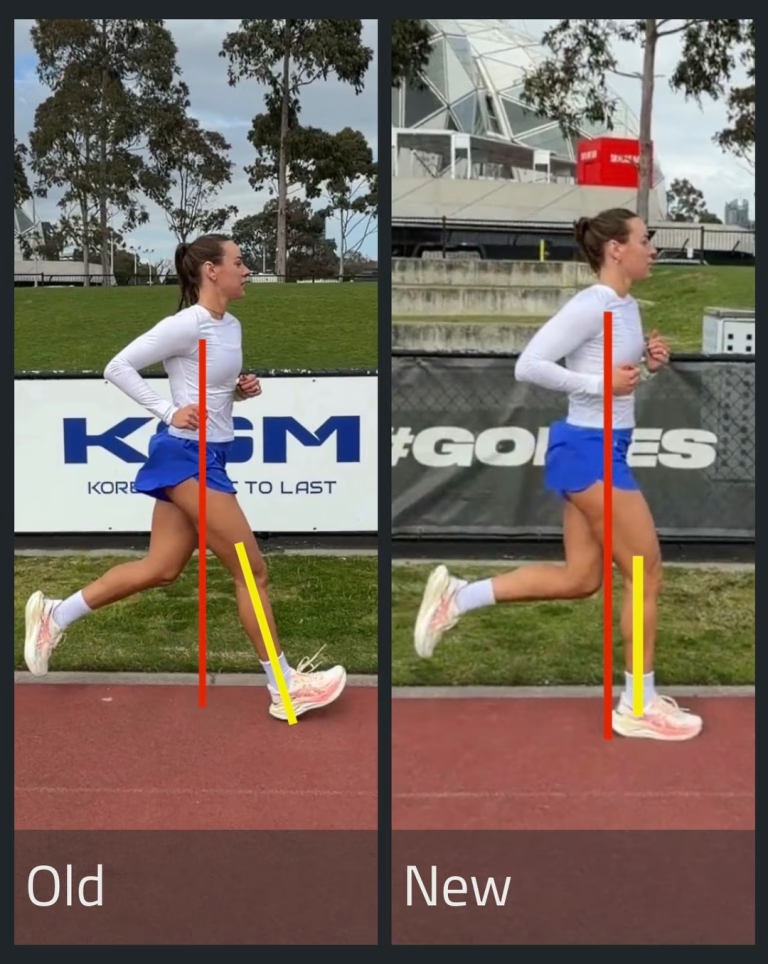
Overstriding and braking: reading an old-way/new-way comparison
How to read an old-way/new-way comparison: the landing changes we look for, why we coach the movement rather than the foot, and…
Returning to running with a new movement pattern: Brianna Throssell
How technique work fitted alongside clinical guidance and a gradual mileage rebuild in Brianna Throssell’s return to running.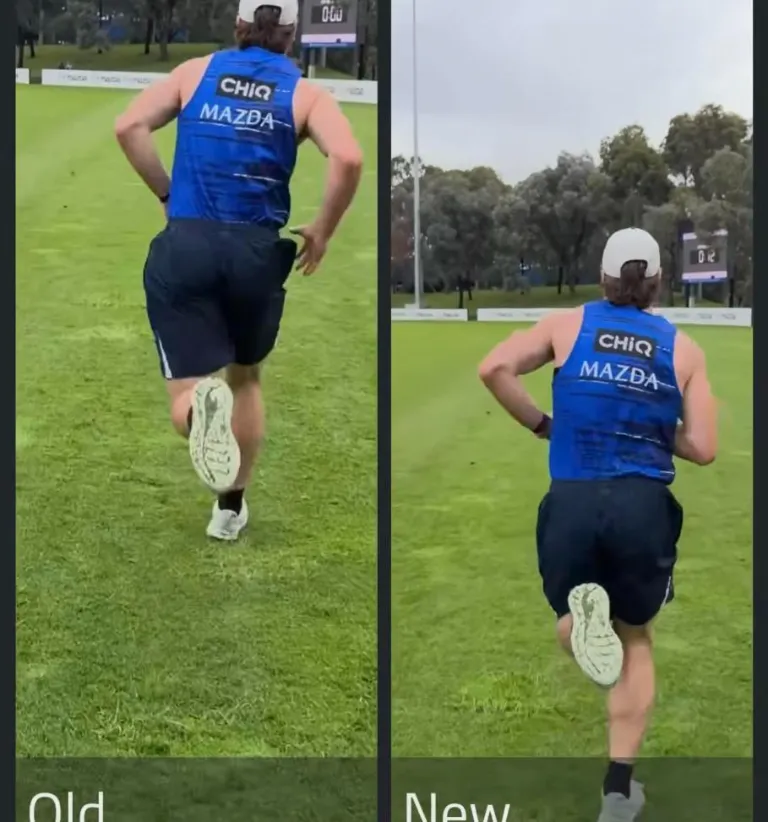
Changing running technique in-season: George Wardlaw
What it takes to change running technique mid-season, from our work with AFL player George Wardlaw.
How upper-body changes can influence your running stride
Why we look above the hips when working on knee drive, foot recovery and symmetry, from a coaching session with Cortney.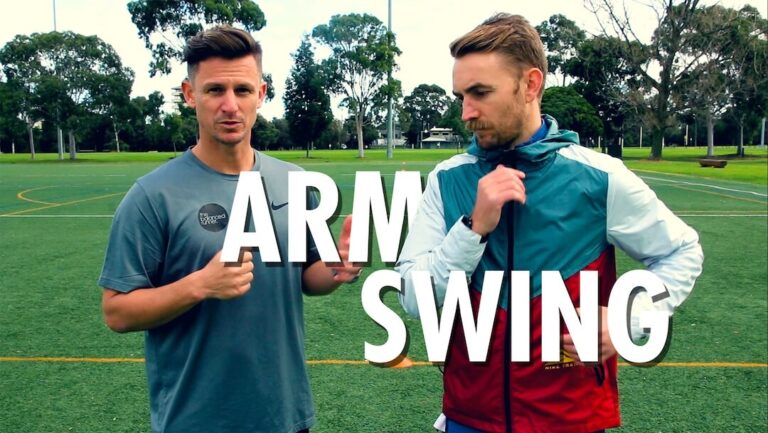
Running arm swing: why your upper arms matter
Why the upper arm matters in running, and how arm movement fits into our approach to technique.
Paul joins The Aerobic Edge: cadence, foot strike and what matters
Paul and Joost Dekker explore why cadence and foot strike are outcomes of movement, and how the arms and torso influence running…
Paul on The Endurance Lab: running faster with less effort
Paul joins Jusman So to discuss running economy, arm swing and the movement cues that can change how running feels.
Paul talks running technique on the Sweat Elite Podcast
Paul’s June 2026 conversation with Matt Fox explores changing running form, practising cues and making new movement patterns habitual.
Paul joins Stronger Stride to talk running technique
In episode 255, Paul discusses the physics of running, body awareness and the movement patterns behind common technique errors.
Paul discusses gait re-education on RunningLifestyleCulture
Paul’s RunningLifestyleCulture appearance explores gait re-education and learning running skills after years of running.
Paul joins The Physical Performance Show
Episode 374 explores Paul’s top-down approach, movement awareness and the difference between coaching inputs and chasing outcomes.
Paul joins The Kaizen Show with Coach Macka
Paul joins Coach Macka for a conversation about running biomechanics, physics, cadence and super shoes.
Improving your Stryd footpath with running technique
Paul Mackinnon’s feature for the Stryd blog: how working on the upper body changed one runner’s Stryd Footpath, and how to use…
Paul talks running biomechanics on All Things Running
Paul and Jacob Rees Montgomery discuss biomechanics for recreational and professional runners, from arm swing to the influence of super shoes.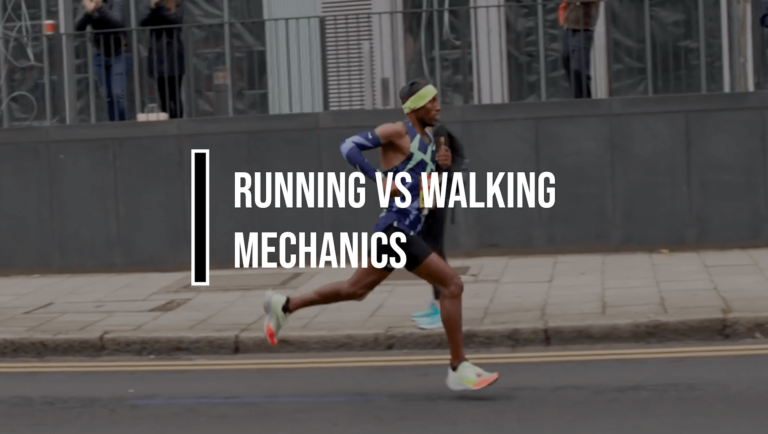
One of the foundations of Running Technique explained – Running vs Walking Mechanic
Paul breaks down the common mechanics in both walking and running, and how using the proper running mechanic can make you more…
Is There An Ideal Cadence When Running?
Cadence in running is so poorly used and in most cases poorly understood.For those wondering, cadence is the number of steps taken…
Paul joins Get Fast Podcast: mastering running form
Paul joins Gerard and Jordy Donnelly for practical discussion of arm movement, cadence and changing running technique.
Broadsheet Feature Article: The Science To Help You Become a Better Runner
Our Broadsheet feature with PUMA on the science of better running, and why anyone can improve with the right movements.
The Ultimate Running Form Episode with the Strength Running Podcast
Paul Mackinnon joins Jason Fitzgerald on the Strength Running Podcast for a deep dive into running form, cues and cadence.
Running Technique learnings from Galen Rupp
I have been lucky enough to work with Galen Rupp a few times over the past year as he looked to get…
Congratulations Brett Robinson – Australian Marathon Record (2022)
I’ve been working with Brett Robinson for a little while now and a few weeks ago in the lead up to the…
Jakob & Henrik Ingebrigtsen Form Comparison
This is just a very short breakdown of the form of the Ingebrigtsen brothers while they jog together.
Paul joins For The Kudos Podcast for a Technique Q&A
Paul has been working with both Brett and Joel over the past couple of years to improve their technique and their performance,…
Running Technique Coaching vs Strength & Conditioning
If you have followed Paul for a while, you will know that he likes to have a bit of fun at the…
Paul joins Bodies Built Better: running efficiently
Paul joins Jackie Tann to discuss efficient running, self-awareness and the movement patterns he looks for in technique coaching.
An example of Stride & Cadence with Paul Chelimo and Luis Orta
I saw this video recently and thought it was a great opportunity to highlight the difference movement can make to running at…
Timing of your movement when running
The timing of your movement is critical when running. This article outlines how to think about this and the affect it can…
How do you hold your shoulders when running?
How do you hold your shoulders when you are running? In this summary, we outline the common issues with tension in shoulders…
How Do You Identify Your Running Technique?
A lot of people don't take the time to be fully aware of what their body is doing while they are running.…
Paul on Relaxed Running: technique and running efficiency
Paul joins Relaxed Running to discuss technique, injury prevention and running efficiency, drawing on his background in hockey and coaching.Free newsletter
Get running tips in your inbox
Technique cues, new articles and program news from Paul Mackinnon, sent straight to you.